

The Burnout Blueprint: 10 Barriers Undermining Digital Creator AND Pluralist Narrative Power
Part 2 of the Pop Culture Collaborative's special digital creator series

TL;DR: In the first post, we nailed the idea that it’s not just about working with digital creators to transform narratives that matter, but how we work with them. We also detailed how pluralist digital creators have advanced powerful narrative strategies. However, there’s a major blockage toward building pluralist narrative power.
Digital creators are doing essential narrative work, yet they face structural barriers to participate as full-throttle stakeholders in our efforts to build transformative pluralist narrative power. Before we talk solutions, let’s unpack what’s standing between digital creators and durable narrative power.
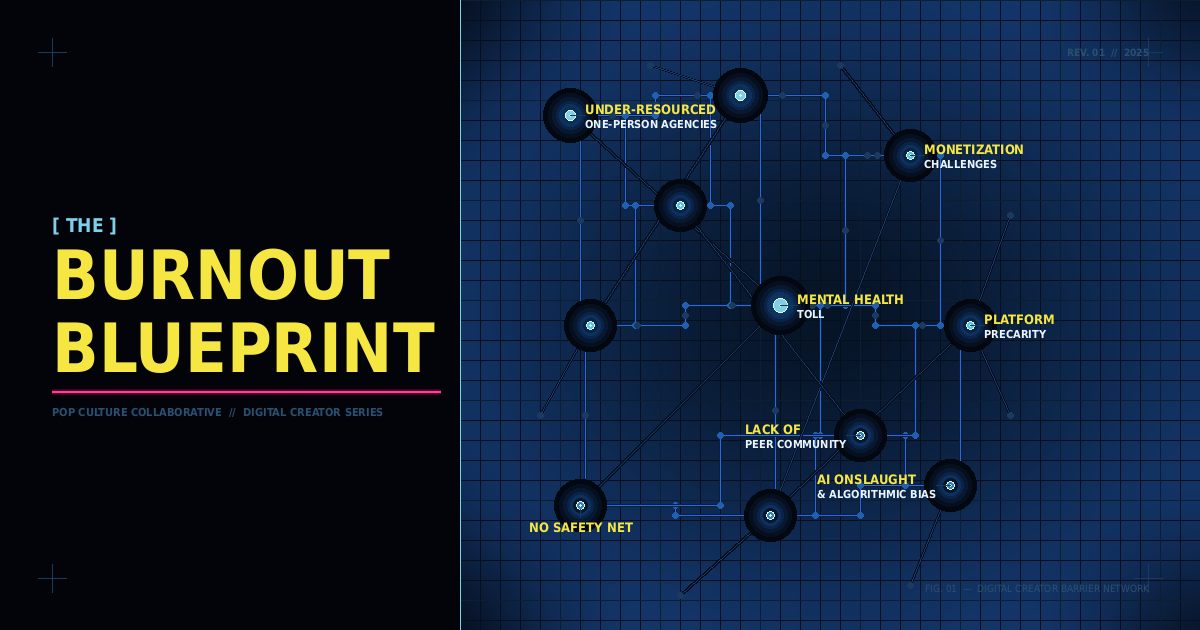
10 REASONS WHY DIGITAL CREATORS ARE BURNING OUT FAST
“We don’t have a lack of talent. We don’t have a lack of people... We just need to invest in them.” — Ashwath Narayanan, Social Currant
In the summer and fall of 2025, the Pop Culture Collaborative partnered with Dot Connector Studio to examine the working environment and needs of digital creators in the cultural, media, and political landscape. Dot Connector conducted interviews with five organizations directly organizing, hiring, investing in, or partnering with digital creators: Digital Media Management, Social Currant, and Watering Hole Media, as well as two social justice organizations—Inevitable Foundation and United We Dream.
What emerged: 10 structural challenges driving burnout, instability, and creative precarity. Is this list exhaustive, and does it contain all nuances? Nope. But it captures much of the moment we’re in and the barriers that digital creators face.
UNDER-RESOURCED ONE-PERSON AGENCIES.
Many creators function as one-person agencies, managing production, editing, finances, legal matters, marketing, and strategy entirely alone. They juggle business, technology, and creative demands with little institutional or peer support. For example, 77% of news influencers operate independently—isolated from professional support structures, collective bargaining power, and legal and institutional protections. There is no shared “guidebook” for building a digital creator business, leaving many to learn contract negotiation, tax planning, IP protection, and platform strategy through costly trial and error.
MONETIZATION CHALLENGES AND DISPARITY.
Creators struggle to earn stable income. Most rely on paid partnerships and brand deals (74% of creators cite this as their top revenue source), but platform creator funds pay very little and reach only a small share of creators—only 16% of creators earn anything from them, and the amounts are typically unsustainable for full-time work. In addition, there are pay disparities. The racial pay gap between White influencers and Black influencers? As high as 35%. Many creators also lack support to diversify revenue streams or build media properties they own—leaving them dependent on platform monetization models that extract value without building long-term equity.CHRONIC MENTAL HEALTH TOLL.
Creators face chronic isolation, online harassment, and financial barriers to mental health care—all of which contribute to serious burnout. There is no infrastructure support. This quote says it all:“[...] Burnout is very real for these creators… I’ve seen a lot of people who’ve experienced mental health challenges as a result of being a content creator, working in a highly political environment. And a lot of these people maybe don’t necessarily have the skills or tools or set out to be political and maybe they were a food creator and next thing you know, they’re trying to navigate the daily political landscape.” – Dave Giglio, Digital Media Management
LACK OF PROFESSIONAL STANDARDS.
Digital creators often operate without established industry standards or professional norms. This absence of shared standards can undermine accountability and credibility. Many creators lack access to verification protocols, ethical guidelines, or organizational structures, which can reduce trust in their content.NO SAFETY NET.
The field remains largely unstructured—without shared standards, labor protections, or established networks—leaving creators to navigate complex business, strategy, and technology demands alone. Without guidance on contracts, intellectual property, or rights management, creators are vulnerable to exploitation, harassment, and emerging AI-related risks such as impersonation and content theft. Minimal labor protections and few benefits intensify precarity and burnout, even for highly skilled creators. And few creators have access to digital safety resources or rapid response protocols when facing coordinated harassment or misinformation campaigns.PLATFORM OWNERSHIP AND PRECARITY.
Shifts in platform ownership, such as Elon Musk’s acquisition of X, have directly benefited anti-pluralist voices, allowing previously banned or fact-checked creators to return to mainstream visibility. Sudden changes to community guidelines, algorithmic controls, or content moderation determine what gets seen—and can shut down a creator’s reach overnight, disproportionately harming those working on civic and social issues. And it’s getting worse. The algorithms themselves are shifting rightward, which is both creating censorship and enabling digital harassment.LIMITED CREATIVE PRACTICE AND MISINFORMATION GUIDANCE.
The always-on pace of digital production leaves little room for digital creators to experiment or engage in creative risk-taking. Client demands and algorithmic pressures often dictate what and how content gets made. And creators—especially those producing news or civic content—need access to trusted, real-time information amid rising misinformation. But here’s a troubling stat: 62% of content creators surveyed reported not checking the accuracy of content before sharing.“In these nonprofit or philanthropic funded spaces, there’s this intention that every dollar, especially on the left, has to create this measurable clear impact. And that mentality doesn’t really work that well in media creation where there’s so much experimentation and creativity and it’s hard to really be predictive or determinative in your work.” – Brandon Sharp, Watering Hole Media
AI ONSLAUGHT AND ALGORITHMIC BIAS.
AI-generated content is rapidly increasing, churning out professional-looking videos, posts, and messaging at a fraction of the cost and time required by human creators. Synthetic AI influencers (computer-generated personalities capable of producing eerily realistic video, audio, and text content) are reshaping the political and cultural landscape at breakneck speed. During the February 2025 German elections, AI-generated influencers designed as young, attractive women supported the far-right party Alternative für Deutschland (AfD). The line between AI-generated and human-produced content is rapidly blurring, and human creators risk being outpaced and overshadowed without the space and support to innovate and maintain authenticity. Meanwhile, many creators are looking to AI-enabled tools to support production, editing, and testing of their content, but don’t have access to or training in the tools that could expand their capacity as one-person agencies.LACK OF CREATOR PEER COMMUNITY.
Creators are hungry for connection with their peers. They need peer communities where they can share strategies, resources, and struggles. They need in-person gatherings that combat the isolation of digital-only work. They need mentorship from experienced creators. But right now, these support systems are largely informal and insufficient.BARRIERS TO AUDIENCE EXPANSION AND COMMUNITY BUILDING.
Many creators are working against the algorithm, lack marketing dollars, and need to build their own peer distribution networks. In addition, as the media environment shifts, we know that audiences aren’t just the end goal, but transitioning their audiences into robust communities—where audiences move into active engagement with ideas and with each other—is critical. In these spaces, people create together, play together, take action together, and make meaning with one another—leading to a more durable sense of belonging and identity formation. Too many creators lack the tools, training, and infrastructure to translate those audiences into durable, values-aligned communities. Without support to develop community-building strategies, creators remain dependent on volatile platforms and one-way engagement rather than being in a position to build and maintain participatory communities where people are in relationship with one another, shaping beliefs together and practicing shared values over time.“I haven’t seen a lot of how do you build a community as a creator with your audience and how do you help that sustain you while also deepening your relationship with them sort of training.” — Ashwath Narayanan, Social Currant
THE BOTTOM LINE
Digital creators are doing essential cultural, narrative, and community-building work that social impact organizations increasingly rely on, but without the support systems that other cultural and media professions were built on. The result: burnout, instability, and a digital narrative field that struggles to sustain the very creators shaping meaning-making every day. We can’t treat digital creators only as one-off campaign partners.
In our next post, we’ll unpack a set of digital creator content partnership models matched with corresponding narrative advantages and creator sustainability opportunities.
Funders interested in learning more about pop culture narrative strategy: reach out to s.flaster@popcollab.org to discuss this series or learn about Imagination Requested, the Pop Culture Collaborative’s narrative strategy masterclass.
Pop Culture Collaborative is North America’s leading narrative change funder, harnessing the exponential influence, scale, and speed of pop culture to build narrative power and momentum for a just and pluralist future.
Dot Connector is an imagination, foresight, and restoration firm that cultivates futures learning with philanthropy, arts, culture, and social impact leaders.